Neurocritical care topics are covered frequently on the neurology Board and RITE* exams. Your expected knowledge of these topics, however, is less in-depth than other neurology topics. Here, we will cover the high-yield neurocritical care topics covered on these exams.
Author: Steven Gangloff, MD
Disorders of Consciousness
- Arousal is primarily governed by the ascending reticular activating system (ARAS) located in the pons and midbrain tegmentum.
- The ARAS has output to the reticular nucleus of the thalamus.
Definitions of states of consciousness
- Drowsy: arousable with mild stimuli.
- Delirium: waxing and waning consciousness, with impaired attention.
- Stupor: arousable only to vigorous stimulation.
- Unresponsive wakefulness: Formerly known as “persistent vegetative state.” Unresponsive to stimulation, but with the return of sleep-wake cycles and autonomic maintenance.
- Coma: not able to be aroused.
- The word “obtunded” is poorly defined and should be avoided.
Brainstem Reflexes
- Pupillary: CN II (afferent) → CN III (efferent)
- Oculocephalic: CN VIII (afferent) → CNs. III, IV, VI (efferent)
- Caloric: CN VIII (afferent) → CNs. III, IV, VI (efferent)
- Corneal: CN V1 (afferent) → VII (efferent)
- Gag: CN IX (afferent) → CNs IX & X (efferent)
Traumatic Brain Injury (TBI)
- Common causes of TBI include falls, motor vehicle accidents, assaults, explosive blasts, and penetrating injuries.
- The more severe the TBI, the higher the risk for the development of focal epilepsy.
- Radiographic findings consistent with TBI:
- Skull fractures
- Cerebral contusions, typically in areas where brain parenchyma rubs against skull bone (i.e. inferior temporal and frontal lobes)
- Coup contusions occur on the side of the trauma.
- Countercoup contusions occur on the opposite side of the site of impact.
- Pneumocephalus due to penetrating injury or skull fracture.
- Can be associated with pneumolabrinth (air in the inner ear).
- Cerebra edema
Diffuse axonal injury
- Due to shearing forces from extreme acceleration and deceleration.
- A biopsy will have swollen proximal ends of axons in the appearance of bulbs known as “retraction balls.” Punctate hemorrhages may also be seen.
Basilar skull fracture
- Battle’s sign (ecchymosis of the mastoid region) and raccoon eyes (periorbital ecchymosis) may be seen.
- May also have leakage of CSF from the ears (otorrhea) or nose (rhinorrhea).
- Can test rhinorrhea or otorrhea for β-transferrin, to determine if a CSF leak is present, as this is only positive in CSF.
Non-accidental trauma in a child
- Suspicious signs include spiral fracture of the humerus, immersion burns, rib fractures, retinal hemorrhages (from shaking), long bone injuries, duodenal hematomas, brain contusions, subdural hematoma, and skull fracture.
Spinal Cord Trauma
- For information on spinal cord anatomy and localization of lesions, see our Spinal Cord chapter.
Spinal Shock
- Disruption of autonomic sympathetic function causes unopposed parasympathetic activity, which presents with bradycardia and hypothermia.
- Caused by lesions in the spinal cord above T6. Can treat with α-agonist and β-agonist medications.
- The major causes of death after spinal trauma are spinal shock and aspiration.
Treatment
- Hypothermia and corticosteroids can be considered.
Brainstem Trauma
- In depth review of brainstem anatomy and brainstem strokes can be found in our Anatomic Syndromes and Vascular Neurology chapters.
Breathing Patterns
- Apneustic breathing: Respiratory pauses at end-inspiration and end-expiration. Caused by a pontine lesion.
- Ataxic breathing: Irregular arrhythmic breathing. Caused by a medullary lesion.
- Cheyne-stokes breathing: Cyclical breathing pattern that alternates between a crescendo and decrescendo of breathing amplitudes and central apneas. Associated with heart failure and bilateral cortical or deep brain structure injury (TBI, stroke, etc.).
Posturing
- Decorticate posturing: the lesion is above the red nucleus.
- Decerebrate posturing: the lesion is between the red nucleus and vestibular nucleus (i.e. below the red nucleus).
Subarachnoid Hemorrhage
- Subarachnoid hemorrhage and its complications are commonly treated in the ICU. For other high-yield intracranial hemorrhages, see our Vascular Neurology chapter.
- Often from aneurysm rupture.
- Aneurysms are most commonly in the circle of Willis, specifically the anterior communicating artery (A. comm) is most common.
Vasospasm
- Risk at days 3-14, peak at 6-8.
- If you see a sudden decline in a patient at 1-2 days after admission for an unsecured aneurysm, suspect rebleed.
- If you see a sudden decline at 3-14 days, suspect vasospasm.
- Diagnosis is made clinically and supported by narrowing on CT angiogram or cerebral angiogram, or increased velocity on transcranial dopplers (TCDs).
- TCDs can be performed daily.
- Prevention:
- Nimodipine: Calcium channel blocker, given q4h for 21 days.
- Pravastatin has been shown to reduce delayed ischemic events from vasospasm and to improve outcomes.
- Treatment:
- Maintain euvolemia.
- Intra-arterial therapy such as balloon angioplasty or direct infusion of vasodilators can be considered.
Hunt and Hess grading scale
- A clinical grading scale.
- Grade 1: Asymptomatic
- Grade 2: Headache, no other finding besides possible cranial nerve involvement
- Grade 3: Confusion, drowsiness, or mild focal neurologic impairment
- Grade 4: Stupor, moderate to severe hemiparesis
- Grade 5: Deep coma
Fisher grading scale
- A scale based on CT findings
- Grade 1: No SAH seen on CT
- Grade 2: Blood layer <1 mm thick on CT
- Grade 3: Blood layer ≥1 mm thick on CT
- Grade 4: Intracerebral or intraventricular spread.
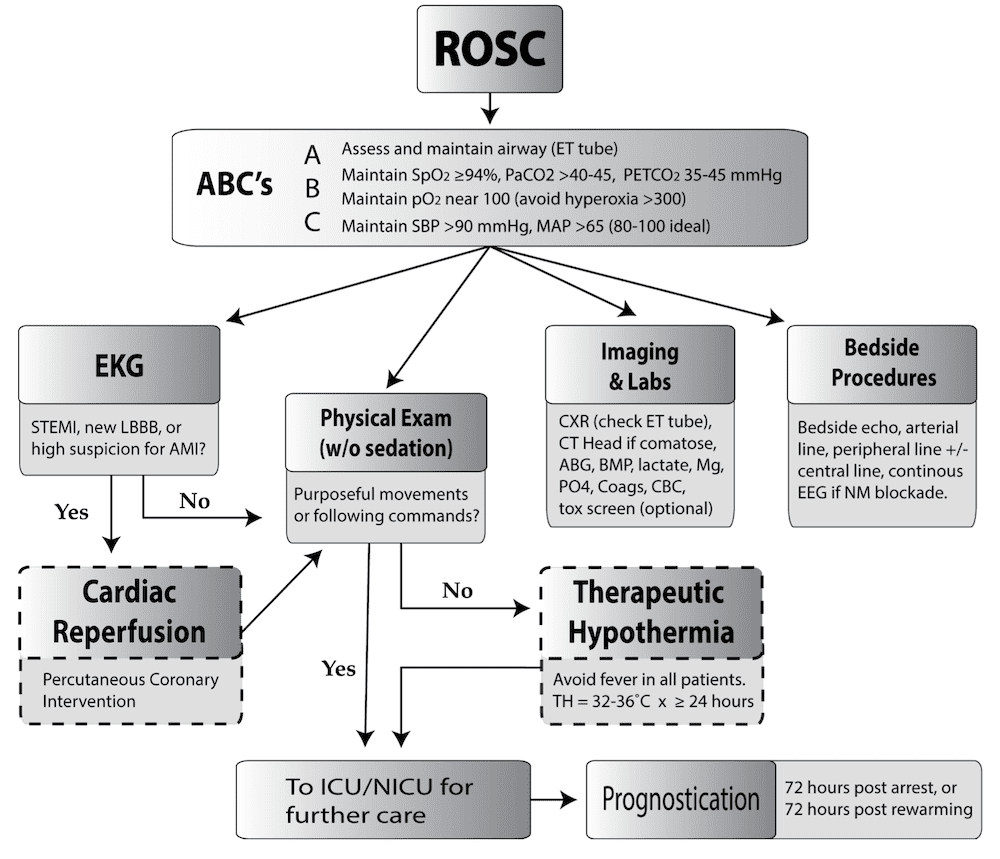
Post-Cardiac Arrest Care
Goals
- Optimize organ perfusion
- Optimize ventilation
- Optimize temperature.
- Identify the cause of arrest
- Prognosticate
Ventilation
- Low PaCO2 can cause cerebral vasoconstriction, so avoid hyperventilation.
- Hyperventilation lowers PaCO2
Circulation
- Optimize cerebral perfusion using a target MAP (mean arterial pressure)
- Norepinephrine or other catecholamines can be used. Dobutamine or milrinone can be used to increase cardiac output if global hypokinesia of the heart is seen on echocardiogram.
Physical exam
- Tachycardia is expected after return of spontaneous circulation (ROSC) is achieved.
- If bradycardia is seen, consider hypoxia or metabolic disturbance.
Treatment
- Therapeutic hypothermia
- Cool to 32-36° C for ≥24 hours
- Propofol and fentanyl decrease shivering, which can help to decrease body temperature.
- After cooling, re-warm
- Monitor for cardiac arrhythmias (bradycardia, atrial fibrillation, ventricular tachycardia).
- Most common complication during hypothermia protocol
- Glucose control
- Keep between 140-180 mg/dL.
- PCI
Prognostication
- Prognostication should be performed at 72 hours post-arrest or 72 hours post-re-warming
- Continuous EEG may aid in prognostication.
- Risk factors for poor prognosis after cardiac arrest:
- Bilateral absence of N20 response on somatosensory-evoked potentials is the strongest predictor of a poor outcome.
- Longer time to ROSC
- Absence of brainstem reflexes 3 days post-resuscitation
- Extensor or no motor response
- Lower pH and/or higher lactate
- Elevated neuron-specific enolase
- Hypotension requiring >2 vasopressors
- Absence of reactivity on EEG
- Burst-suppression pattern on EEG
- Burst-suppression or a low voltage (<20 µV) EEG at 24 hours post-arrest has been reported to have a 99-100% chance of a poor outcome.
- Normal background without discharges has been reported as high as a >70 % chance for a good outcome.
Cerebral Edema and Elevated Intracranial Pressure
Intracranial Pressure (ICP)
- Normal ICP is 5-15 mmHg.
- Increases in pCO2 cause vasodilation and thus increase ICP.
- Hyperventilation causes decreased pCO2 and therefore decreased ICP. This can be helpful in intracerebral hemorrhage or edema patients, but detrimental in post-cardiac arrest since ICP goals are different.
- The response to hyperventilation, though, is only temporary and can have a significant rebound.
- A ventricular drain can be used to measure intracranial pressure (ICP) over time.
Mean Arterial Pressure (MAP)
- The ideal range is variable, but typically 60-150 mmHg
- MAP = DBP + 1/3 (SBP – DBP)
- (Systolic Blood Pressure = SBP, Diastolic Blood Pressure = DBP)
Cerebral Perfusion Pressure (CPP)
- CPP should be >70 mmHg ideally, with a lower limit of 50 mmHg.
- CPP = MAP – ICP
Forms of Brain Edema
Vasogenic edema
- Extracellular edema.
- Damage to the blood-brain barrier causes fluid extravasation out of the intravascular space.
- Examples include tumors
Cytotoxic edema
- Intracellular damage
- Due to damage to the cellular membrane itself, such as with an ischemic stroke.
Interstitial Edema
- Increase in brain fluid due to blockage of CSF flow. An example is obstructive hydrocephalus.
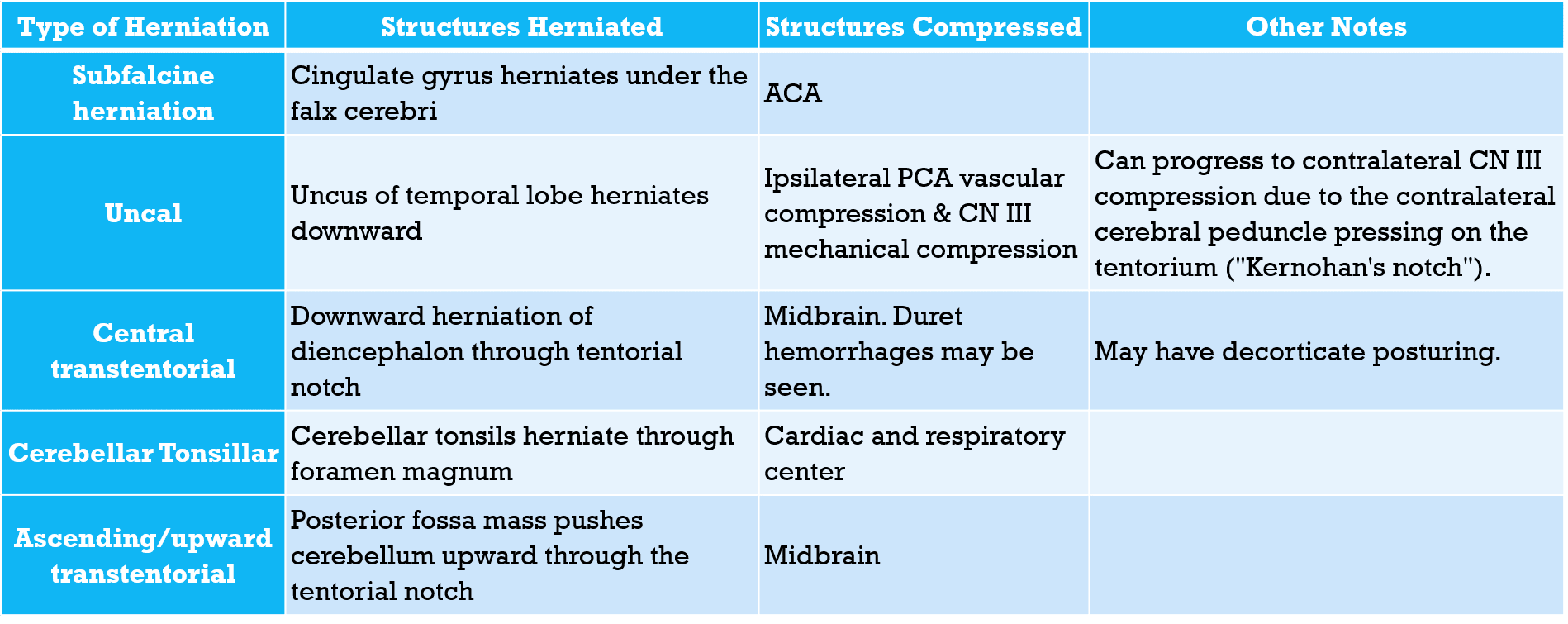
Forms of Herniation
Treatments of Brain Edema / Increased ICP
- Head of bed at 30 degrees
- Hypertonic saline
- Mannitol
- Decompression
- Drainage of CSF
- Glucocorticoids (for vasogenic edema only)
- Rarely, the following can be considered:
- Hyperventilation: rapid effect but short-lived (<24 hours) and may have a rebound.
- Barbiturate coma
- Pharmacologic paralysis
- Hypothermia
Brain Death
- Brain death testing must be performed in the appropriate patient setting:
- No pharmacologic sedation, neuromuscular blockade, or intoxication
- Normal body temperature (>36 degrees)
- Systolic blood pressure >90 mmHg or MAP >60 mmHg.
Brain death testing
- EEG: Electrographic silence >30 minutes.
- Angiogram: No flow in the circle of Willis.
- TCD: No flow signals, or abnormal oscillating or low amplitude signals.
- PET: No signal uptake in the brain.
- Apnea test:
- The patient is oxygenated with 100% O2 for 15 to 30 minutes.
- Arterial blood gases are collected, then the ventilator is turned off.
- The test is positive (supporting brain death) if there is no breathing effort and the PaCO2 is > 60 mmHg, or if there is an increase of 20 mmHg in PaCO2 above the normal baseline level.
Status Epilepticus
- Status epilepticus is an emergency. Delayed time to treatment increases the chance of medication resistance, and death.
- Status epilepticus carries an ~20% chance of death.
Status Epilepticus Treatment:
Hyperthermia
Malignant hyperthermia
- Autosomal dominant, ryanodine receptor mutation.
- Triggered by the use of anesthesia (typically succinylcholine).
- Causes muscle rigidity, hyperthermia, autonomic instability, rhabdomyolysis, and altered mental status.
- Treatment: Stop the offending agent and give dantrolene: blocks release of calcium from the sarcoplasmic reticulum.
Neuroleptic malignant syndrome (NMS)
- Similar presentation to malignant hyperthermia, but the triggering agent is an antipsychotic.
- Treatment: Removal of the offending agent(s). Use bromocriptine (dopamine agonist), amantadine, and/or dantrolene for severe cases.
Serotonin syndrome
- Presents with altered mental status, neuromuscular hyperactivity (tremor, myoclonus, rigidity and hyperreflexia), and autonomic hyperactivity (diaphoresis, hyperthermia, tachycardia, tachypnea).
- Mediated by excessive agonism of serotonin 5-hydroxytryptamine receptors 5-HT1A and 5-HT 2A.
- Common causes: MAOIs, SSRIs/SNRIs, bupropion, TCAs, dihydroergotamine (DHE), triptans and dextromethorphan.
- Treatment: Removal of offending agent(s). Benzodiazepines and cooling for symptomatic control. Cyproheptadine (MOA: nonspecific serotonin antagonism) can be used in severe cases.
Neuroleptic malignant syndrome vs. Serotonin syndrome
Both syndromes present similarly but clinical history often helps differentiate between the two. Additionally, shivering and myoclonus are seen with serotonin syndrome and NOT NMS!
Sedative Medications in the ICU
Propofol
- Sedative medication, that can also decrease ICP.
- Binds to GABA receptors.
- Fast on and off of sedation.
- Propofol is lipophilic, so in obese patients, the “off time” may be extended a bit longer.
- Side effects: hypotension, respiratory depression, and hypertriglyceridemia.
- Can also decrease ICP.
- Propofol Infusion Syndrome is rare but can be lethal. Signs include lactic acidosis, hyperlipidemia, and rhabdomyolysis.
Dexmedetomidine
- Alpha-2 receptor agonist
- Side effects: bradycardia and hypotension.
Barbiturates
- Barbiturates also reduce cerebral metabolic activity. This, in turn, reduces cerebral blood flow and thus decreases ICP.
- Pentobarbital coma can be considered as a treatment option in elevated ICP.
- Side effects: hypotension, bradycardia, hypothermia.
Benzodiazepines
- Short-acting (2- to 5-hour half-life) benzodiazepines (midazolam) are useful due to fast on and off times.
- Intermediate half-life benzodiazepines (6-24 hours): lorazepam, alprazolam
- Long half-life benzodiazepines (>24 hours): clonazepam, diazepam, flurazepam
Other
Critical Illness Myopathy (CIM)
- Presents with diffuse weakness often in a critically ill patient.
- EMG will show reduced motor responses and prolonged CMAP durations due to selective loss of myosin filaments.
- For EMG findings of CIM, see our EMG Case Bank: Myopathy Case #1
- High-dose steroid use, sepsis, SIRS, and multiorgan failure are risk factors.
- Patients with critical illness myopathy often also have concurrent critical illness polyneuropathy (CIP).
- CIP is a distal axonal sensorimotor polyneuropathy that leads to limb weakness or difficulty weaning off artificial ventilation.
- Patients with critical illness myopathy often also have concurrent critical illness polyneuropathy (CIP).
- Symptoms can take months to years to recover and one-third of patients never walk independently again.
References
- Unterberg, A. W., Stover, J., Kress, B., & Kiening, K. L. (2004). Edema and brain trauma. Neuroscience, 129(4), 1019-1027.
- Lazaridis, C., Neyens, R., Bodle, J., & DeSantis, S. M. (2013). High-osmolarity saline in neurocritical care: systematic review and meta-analysis. Critical care medicine, 41(5), 1353-1360.
- Kinoshita, K. (2016). Traumatic brain injury: pathophysiology for neurocritical care. Journal of intensive care, 4(1), 29.
- Marmarou, A. (2007). A review of progress in understanding the pathophysiology and treatment of brain edema. Neurosurgical focus, 22(5), 1-10.
- Sivaraju, A., Gilmore, E. J., Wira, C. R., Stevens, A., Rampal, N., Moeller, J. J., … & Gaspard, N. (2015). Prognostication of post-cardiac arrest coma: early clinical and electroencephalographic predictors of outcome. Intensive care medicine, 41(7), 1264-1272.
- Rosner, M. J., Rosner, S. D., & Johnson, A. H. (1995). Cerebral perfusion pressure: management protocol and clinical results. Journal of neurosurgery, 83(6), 949-962.
- Brophy, G. M., Bell, R., Claassen, J., Alldredge, B., Bleck, T. P., Glauser, T., … & Treiman, D. M. (2012). Guidelines for the evaluation and management of status epilepticus. Neurocritical care, 17(1), 3-23.
- Lee, K. H., Lukovits, T., & Friedman, J. A. (2006). “Triple-H” therapy for cerebral vasospasm following subarachnoid hemorrhage. Neurocritical care, 4(1), 68-76.
- Tseng, M. Y., Czosnyka, M., Richards, H., Pickard, J. D., & Kirkpatrick, P. J. (2005). Effects of acute treatment with pravastatin on cerebral vasospasm, autoregulation, and delayed ischemic deficits after aneurysmal subarachnoid hemorrhage: a phase II randomized placebo-controlled trial. Stroke, 36(8), 1627-1632.
- Soleimanpour H, Rahmani F, Golzari SE, Safari S. Main complications of mild induced hypothermia after cardiac arrest: a review article. J Cardiovasc Thorac Res. 2014;6(1):1-8. doi:10.5681/jcvtr.2014.001
- Spencer, M. T., & Bazarian, J. J. (2003). Are corticosteroids effective in traumatic spinal cord injury?. Annals of emergency medicine, 41(3), 410-413.
- Alderson, P., & Roberts, I. (2005). Corticosteroids for acute traumatic brain injury. Cochrane database of systematic reviews, (1).
Loading table of contents...
Log in to View the Remaining 60-90% of Page Content!
Important: If you signed up after 1/1/2026, or if you opted to migrate your old account to the new & improved platform (same great content, better experience), please log in at nowyouknowmed.com

New here? Get started!
(Or, click here to learn about our institution/group pricing)1 Month Plan
Full Access Subscription
$142.49
$
94
99
1 Month -
Access to full question bank
-
Access to all flashcards
-
Access to all chapters & site content
3 Month Plan
Full Access Subscription
$224.98
$
144
97
3 Months -
Access to full question bank
-
Access to all flashcards
-
Access to all chapters & site content
1 Year Plan
Full Access Subscription
$538.47
$
338
98
1 Year -
Access to full question bank
-
Access to all flashcards
-
Access to all chapters & site content
Popular