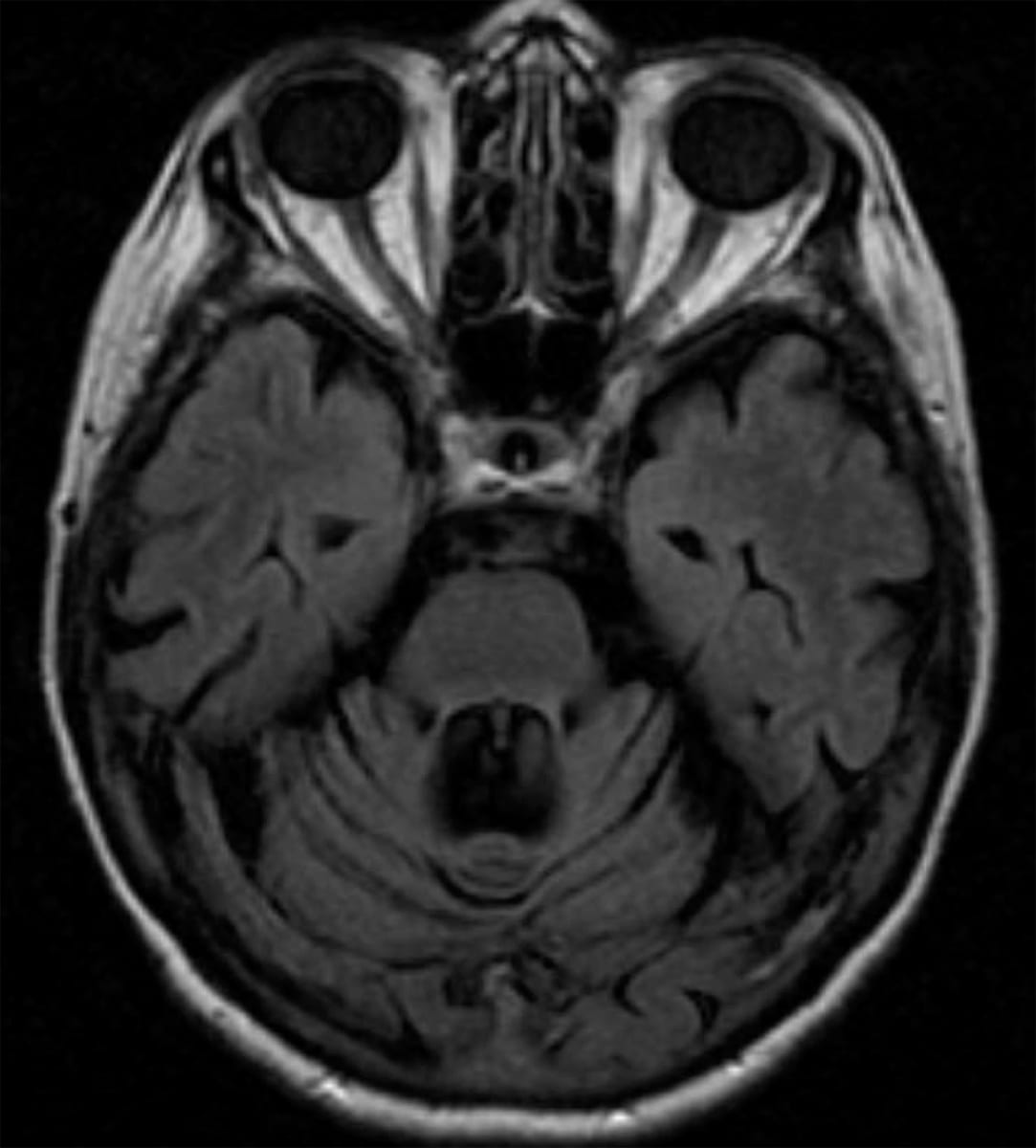
The basal ganglia are an integral component of the central nervous system required to facilitate voluntary movement. Many small subcortical structures encompass the basal ganglia and the interaction between them can seem overwhelming. After reviewing this page, it would be wise to go to our Movement Disorders chapter, which meticulously covers various movement disorders associated with basal ganglia dysfunction.
The cerebellum is also very important for voluntary movements. However, it also has a role in maintaining balance as well as procedural memory. The microscopic anatomy of the cerebellum has been thoroughly researched and is complex. We will cover some of the basic interactions between various cell types within the cerebellum as well as the interactions between the cerebellum and other central nervous system structures (brainstem, spinal cord, thalamus, and cortex).
The content depth of this chapter was decided based on what we felt residents would be expected to know for their in-service and board examinations. If interested in learning more about the basal ganglia we recommend the textbook Neuroanatomy through Clinical Cases.
Author: James Eaton, MD
Editor: Brian Hanrahan, MD
The Basal Ganglia
- The basal ganglia have multiple roles in the nervous system and include fine-tuning movements, reward functions, cognition, and memory.
- It encompasses numerous subcortical regions including the putamen, caudate, nucleus accumbens, globus pallidus (interna and externa), the subthalamic nucleus, and substantia nigra.
- Other terminologies for the basal ganglia regions include the following:
- Striatum: Caudate, nucleus accumbens, and putamen.
- Lenticular nucleus: Putamen, globus pallidus (has the external and internal segments).
- The current model for understanding basal ganglia function is the direct and indirect pathways, these are an oversimplification but work as a useful schema.
- Direct pathway: Cortex projections travel to the putamen which sends inhibitory projections to the globus pallidus internal (GPi) and substantia nigra reticulatum (SNr). The GPi/SNr, in turn, sends inhibitory outflow to the thalamus.
- This disinhibits the thalamus, which facilitates the excitatory thalamocortical pathway.
- The primary neuron receptors in this pathway are D1 receptors.
- Indirect pathway: Cortex projections travel to the putamen, which sends inhibitory projections to the globus pallidus externa (GPe), where inhibitory projections then extend to the subthalamic nucleus (STN) with the result of disinhibiting the STN. STN, in turn, has excitatory projections to the GPi.
- Activity from the indirect pathway excites the GPi/SNr which inhibits the thalamocortical pathway.
- The primary neuron receptors in this pathway are D2 receptors.
- The substantia nigra pars compacta (SNc) is a modulator of the basal ganglia, it acts to inhibit the indirect pathway and activate the direct pathway.
- Glutamate is the prime excitatory neurotransmitter in this system in the basal ganglia, and GABA is the prime inhibitory neurotransmitter.
- Direct pathway: Cortex projections travel to the putamen which sends inhibitory projections to the globus pallidus internal (GPi) and substantia nigra reticulatum (SNr). The GPi/SNr, in turn, sends inhibitory outflow to the thalamus.
Basal ganglia-related disorders
- The pathophysiology of many movement disorders can be sorted by the changes that take place in the basal ganglia.
- Hypokinetic movement disorders typically are due to reduced activity in the direct pathway.
- Hyperkinetic movement disorders typically are due to reduced activity in the indirect pathway.
- Many movement disorders have dysfunction of both pathways. For example, Parkinson’s disease has both hypo- and hyperkinetic features. This reflects that the oversimplified model of the direct and indirect pathways does not completely describe the pathologic mechanisms of many movement disorders.
Parkinson’s Disease (PD)
- Patients present with rigidity, masked facies, and resting pill-rolling tremor due to the loss of dopaminergic neurons in the substantia nigra.
- Lesions to the substantia nigra such as stroke can also cause parkinsonism.
- See the Movement Disorders chapter for more.
Hemiballismus
- These are rapid violent uncontrolled flailing movements of an extremity (usually the arm), classically associated with lesions of the subthalamic nucleus.
Chorea and Athetosis
- Chorea and athetosis are hyperkinetic movements described as “dancing” or “snake-like,” respectively. They are generally on a spectrum and can more broadly be called choreoathetosis.
- Chorea is typically more proximal and looks more like “dancing.”
- Athetosis is usually more distal.
- These can develop with a range of lesions within the basal ganglia.
The Cerebellum
Microscopic anatomy
- The cerebellar cortex has three layers: granule layer, Purkinje cell layer, and molecular layer.
- Granular layer: The innermost layer, it contains tightly packed small granule cells that provide excitatory output to other cerebellar cells via parallel fibers.
- Purkinje layer: The middle layer, which contains the cell bodies of Purkinje cells. Purkinje cells provide inhibitory input to the deep cerebellar nuclei (see below).
- Molecular layer: The outermost layer, which contains the dendrites and axons of interneurons (Golgi, basket, and stellate cells).
- Basket and stellate cells: Receive excitatory input from granule cells via parallel fibers and inhibit Purkinje cells.
- Golgi cells: Receive excitatory inputs from granule cell parallel fibers and provide feedback inhibition to granule cells.
Macroscopic anatomy
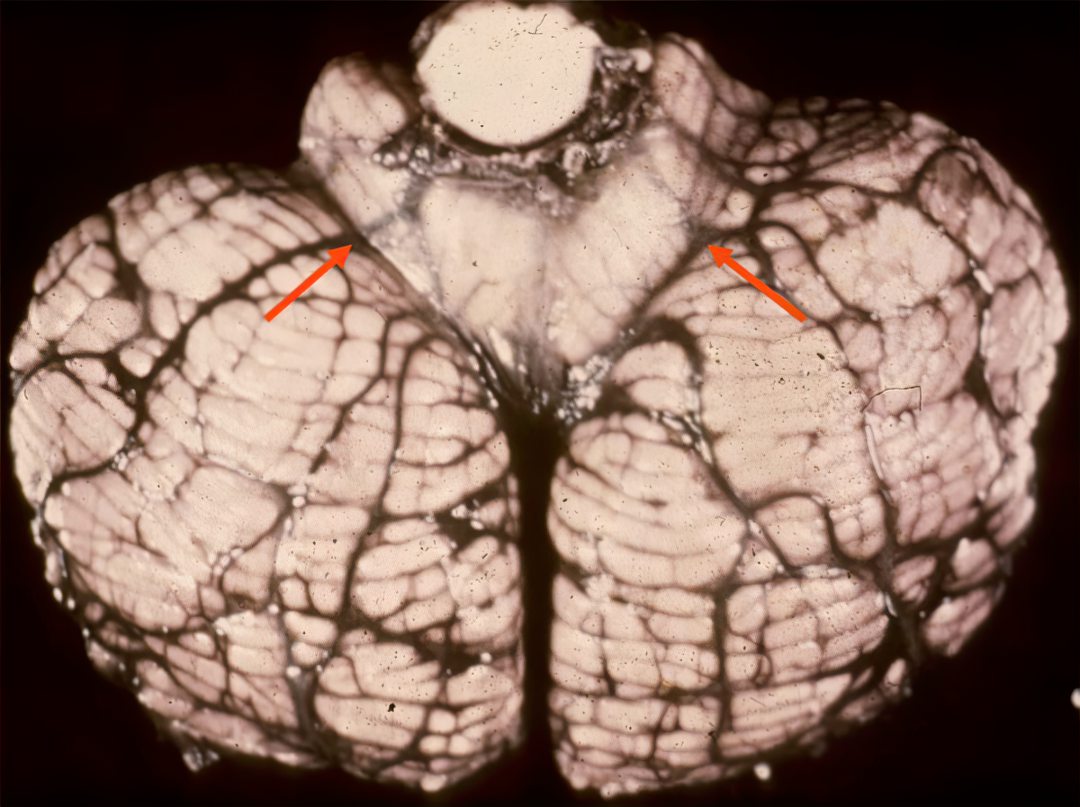
- The cerebellum contains two lateral hemispheres and a midline vermis.
- It is dorsal to the pons and medulla and separated from the occipital lobe via the tentorium
- Cerebellar hemispheres have marked infoldings forming folia.
- With mass lesions, swelling, or elevated intracranial pressure the cerebellum can herniate through the foramen magnum and compress the brainstem.
- Atrophy of the folia can be seen in patients with chronic alcohol use.

Cerebellar Peduncles
- The cerebellum is connected to other brain structures via three paired major white matter tracts: the superior, middle, and inferior cerebellar peduncles.
- The superior cerebellar peduncle contains mostly efferent/output fibers that relay to the thalamus and spinal cord.
- The middle cerebellar peduncle contains input from various regions of the cerebral cortex.
- The inferior cerebellar peduncle primarily contains input from the spinal cord and lower brain stem.
Deep Cerebellar Nuclei
- There are four deep cerebellar nuclei located in cerebellar white matter. These nuclei are called, from lateral to medial, the dentate, emboliform, globose, and fastigial nuclei.
- Deep cerebellar nuclei are the main output centers of the cerebellum, providing efferent fibers that exit the cerebellum via the superior cerebellar peduncle.
- The dentate nucleus is the largest.
- Dysfunction of the dentate nuclei can lead to hiccups or palatal myoclonus as it is part of Mollaret’s triangle, which is made of:
- Ipsilateral red nucleus
- Ipsilateral inferior olivary nucleus
- Contralateral dentate nucleus
- Dysfunction of the dentate nuclei can lead to hiccups or palatal myoclonus as it is part of Mollaret’s triangle, which is made of:
- Emboliform and globose nuclei are sometimes called the interposed nuclei. These nuclei help with initiating movements and keeping movements smooth.
- Fastigial nuclei receive inputs from the vermis and help with walking and stability while standing.
- The dentate nucleus is the largest.
- Input and output fibers decussate resulting in a “double-cross” with the net result of a cerebellar lesion having ipsilateral symptoms.
- White matter tracts that enter the cerebellum via the inferior and middle cerebellar peduncles are called mossy fibers and climbing fibers. These provide excitatory input to the granule and Purkinje cells.
- Climbing fibers originate from the contralateral inferior olivary nucleus
- Mossy fibers originate from several locations including the cortex, vestibular nuclei, and spine.
Vascular Supply to the Cerebellum
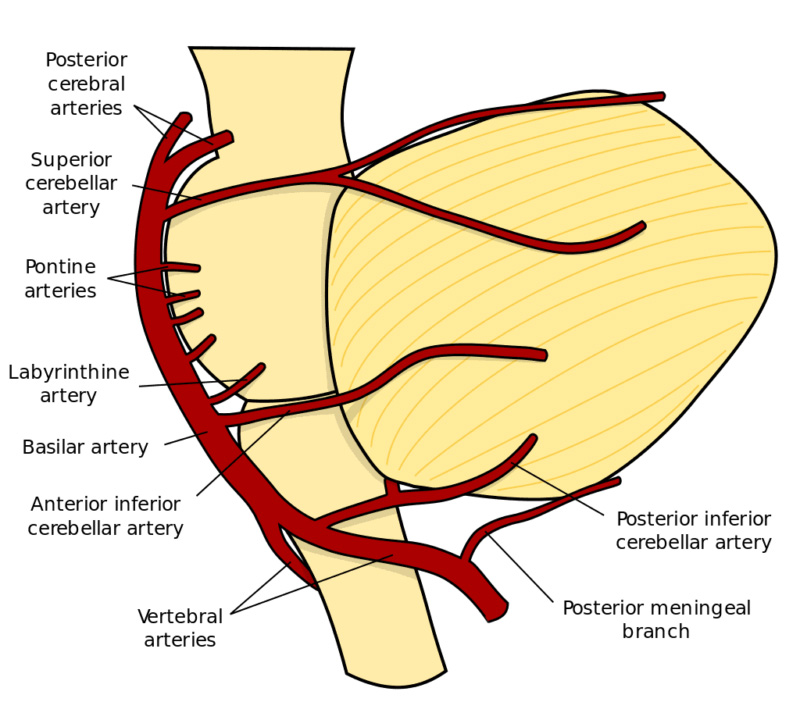
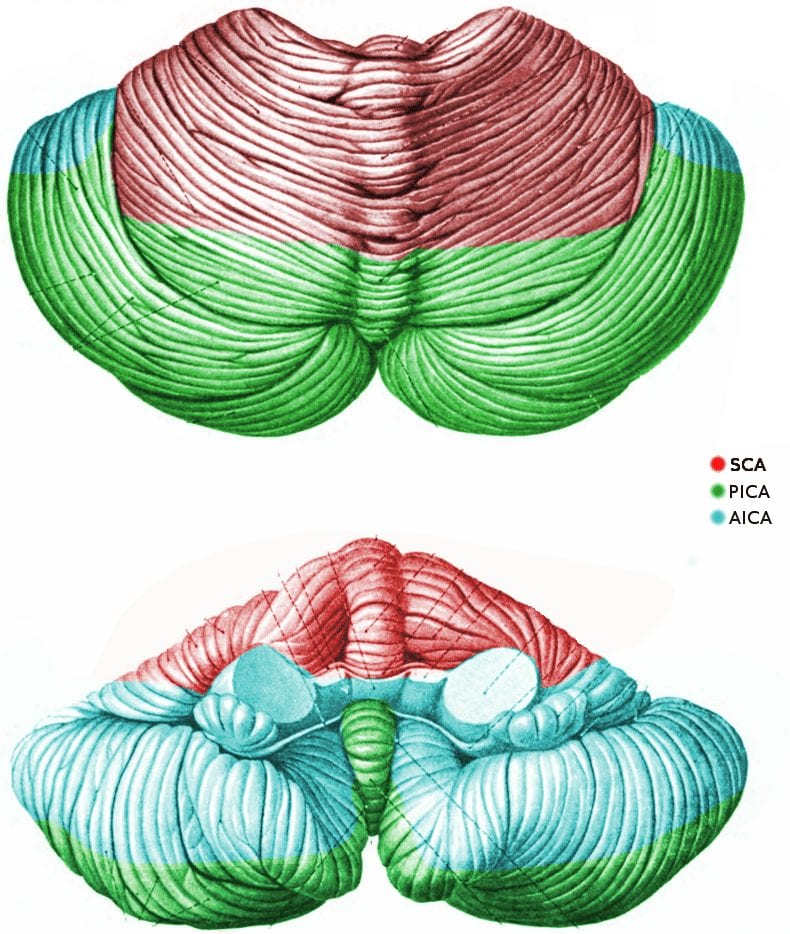
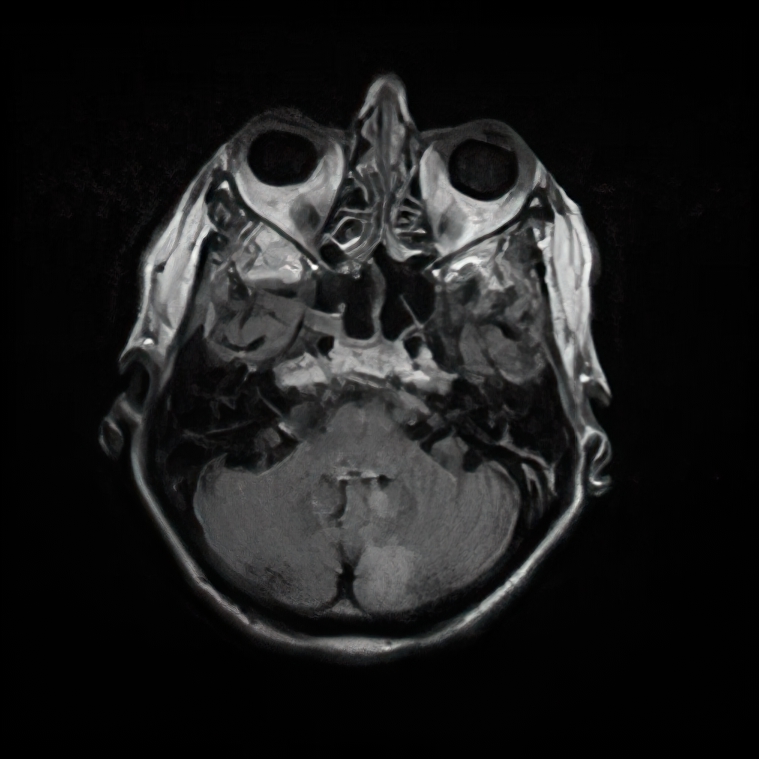
- Three main arteries provide blood supply to the cerebellum: The posterior inferior cerebellar artery (PICA), anterior inferior cerebellar artery (AICA), and the superior cerebellar artery (SCA).
Posterior inferior cerebellar artery (PICA)
- Arises from the vertebral artery.
- This is the largest vascular supply to the cerebellum. It supplies the lateral medulla and most of the posterior and inferior portions of the cerebellum.
- Due to the large vascular supply of the PICA artery, PICA strokes carry a high risk for cerebellar herniation.

- PICA territory strokes are the most common cerebellar stroke. Patients with PICA strokes can present with vomiting, vertigo, horizontal ipsilateral nystagmus, and truncal ataxia. If other PICA-supplied structures are affected patients can present with the lateral medullary syndrome.
Anterior inferior cerebellar artery (AICA)
- Supplies the inferior lateral pons, the middle cerebellar peduncle, and a strip of the anterior cerebellum between the territories of the PICA and SCA.
- AICA strokes are very rare.
- AICA vessel occlusion leads to sudden dysmetria, and vertigo, and ipsilateral sensorineural hearing loss.
- The labyrinthine/internal acoustic artery is a branch of the AICA which supplies the inner ear.
- Occlusion of this artery contributes to hearing loss.
Superior cerebellar artery (SCA)
- Supplies the upper lateral pons, superior cerebellar peduncle, and most of the superior half of the cerebellar hemisphere including the deep cerebellar nuclei.
- SCA strokes can present with ataxia, nystagmus, and dysarthria.
References
- Waxman SG. eds. Clinical Neuroanatomy, 28e New York, NY: McGraw-Hill; http://accessmedicine.mhmedical.com/content.aspx?bookid=1969§ionid=147036871
- Ioannides K, Tadi P, Naqvi IA. Cerebellar Infarct. [Updated 2019 Mar 24]. In: StatPearls [Internet]. Treasure Island (FL): StatPearls Publishing; 2019 Jan-. Available from: https://www.ncbi.nlm.nih.gov/books/NBK470416/
- Macdonell RA, Kalnins RM, Donnan GA. Cerebellar infarction: natural history, prognosis, and pathology. Stroke. 1987 Sep-Oct;18(5):849-55.
- Mancall EL. Basal Ganglia. In: Gray’s Clinical Neuroanatomy: The Anatomic Basis for Clinical Neuroscience. Vol 1. Philadelphia, PA: Elsevier; 2011:247-260.
- Tohgi H, Takahashi S, Chiba K et-al. Cerebellar infarction. Clinical and neuroimaging analysis in 293 patients. The Tohoku Cerebellar Infarction Study Group. Stroke. 1993;24 (11): 1697-701.
Log in to View the Remaining 60-90% of Page Content!
Important: If you signed up after 1/1/2026, or if you opted to migrate your old account to the new & improved platform (same great content, better experience), please log in at nowyouknowmed.com

New here? Get started!
(Or, click here to learn about our institution/group pricing)1 Month Plan
Full Access Subscription-
Access to full question bank
-
Access to all flashcards
-
Access to all chapters & site content
3 Month Plan
Full Access Subscription-
Access to full question bank
-
Access to all flashcards
-
Access to all chapters & site content
1 Year Plan
Full Access Subscription-
Access to full question bank
-
Access to all flashcards
-
Access to all chapters & site content