

Motor neuron diseases, particularly spinal muscular atrophy and amyotrophic lateral sclerosis, are hot topics in neurology and on exams. To understand motor neuron disease is to understand the anatomy of the corticospinal tract, and such anatomy is always useful both on exams and in clinical practice. Here you will find high-yield facts on various motor neuron diseases, and a practice quiz at the end!

Author: Brian Hanrahan MD

Chapter Multimedia Content

Table of Contents
Loading table of contents...

Basics: Corticospinal tract

  • The major descending tract that controls skeletal muscle movements is the corticospinal tract. It is composed of two neurons: the upper motor neuron and the lower motor neuron. Upper motor neurons have their cell bodies in the primary motor cortex of the frontal lobe and their axons travel between the basal nuclei and caudate nucleus as the internal capsule. These axons then traverse through the midbrain as the cerebral peduncle and then decussate upon entering the medulla.
  • Upper motor neuron axons continue in the spinal cord as the corticospinal tract, then synapse on lower motor neurons in the ventral horn of the spinal cord. Lower motor neuron axons then project to skeletal muscle in the periphery (Figure 1).
    motor neuron disease motor corticospinal tract pathway diagram
    Figure 1: Corticospinal tract. Courtesy of OpenStax College, Anatomy & Physiology.

Amyotrophic Lateral Sclerosis (ALS)

  • ALS is a progressive degenerative disorder that causes denervation of the striated muscle.
  • Patients will present with both upper (hyperreflexia, spasticity) and lower motor neuron signs (fasciculations, muscle atrophy). Symptoms are often asymmetric at the onset.
    • Bulbar onset ALS can also occur 25% of the time.
  • Commonly presents in the 5th or 6th decades of life.
  • Progressive symptoms usually lead to respiratory failure and death within 3-5 years.
    • Older age at symptom onset, early respiratory dysfunction, and bulbar onset of symptoms have a worse outcome.
  • ALS is often sporadic, but 5-10% of cases are familial.
    • C9ORF72 (GGGGCC hexanucleotide repeat in a noncoding region)
      • Accounts for 40% of familial ALS (most common cause).
      • Families will also present with concurrent frontotemporal dementia.
    • SOD1 mutation (chromosome 21): encodes for copper/zinc ion-binding superoxide dismutase.
      • Accounts for 20% of familial ALS.
    • Others include TDP-43 and FUS
  • While ALS is a clinical diagnosis, definitive diagnosis is made after EMG/NCS shows denervation .
    • Sensory nerve conduction studies are typically normal.
  • Pathology:
    • On myelin stain cross-sections of the spinal cord, pallor and Wallerian degeneration of the cortical spinal tracts can be appreciated. (Image 1)
motor neuron disease amyotrophic lateral sclerosis spinal cord cross section
Myelin stain: There is symmetric pallor of the lateral funiculi secondary to degeneration of the corticospinal tracts.  Notice also the degeneration of the uncrossed ventral pyramidal tract on one side.
  • Microscopic findings:
    • Inclusion bodies can be found in anterior horn cells.
    • TDP-43 inclusions
      • Seen in most cases of ALS.
      • TDP-43 protein is an RNA binding protein involved with transcription regulation
      • When abnormally phosphorylated and ubiquitinated it leads to various inclusion types (neuronal intranuclear, neuronal cytoplasmic, glial inclusions, etc).
      • TDP-43 inclusions are also seen in half of patients with FTD.
  • Treatment:
    • Riluzole: A glutamate release inhibitor that prolongs survival 2-3 months on average. Common side effects include fatigue and GI issues.
    • Edaravone: FDA approved in 2017, edaravone is a free-radical scavenger shown to inhibit motor neuron death by reducing oxidative stress.
  • ALS variants
    • Primary lateral sclerosis: Presents with UMN symptoms only.
    • Progressive muscular atrophy: Presents with LMN symptoms only.
Multifocal Motor Neuropathy (MMN)

  • Presents with very slowly progressive asymmetric distal predominant weakness and atrophy without sensory symptoms. The upper limbs are predominantly affected.
  • MMN is secondary to an autoimmune attack of myelinated motor fibers leading to demyelination and conduction block at non-compression sites.
    • Anti-GM1 antibodies are present in 50% of cases but it is unclear if these antibodies are pathogenic.
  • Intravenous immunoglobulin (IVIG) can be used to improve disabling weakness but is not curative. Patients will require repeated treatments every 2-6 weeks.
    • Plasma exchange and steroids are ineffective in improving weakness in MMN.

Spinal Muscular Atrophy

  • There are many types of SMA with variable degrees of morbidity/mortality.
    • SMA type 1 (Werdnig Hoffman disease), due to mutation of the Survival motor neuron (SMN1) gene which leads to a loss of function. The symptoms will present in the first 6 months of life.
    • SMA type 4 presents with proximal leg weakness in adulthood. Patients are able to walk independently.
  • SMA is the most common cause of progressive motor neuron disease in infancy but can also present in childhood or as an adult.
  • It is characterized by degeneration of the anterior horn cells resulting in progressive weakness, hypotonia, and atrophy.
  • Muscle biopsies show tiny rounded atrophic fibers (group atrophy).
  • EMGs show normal sensory conduction studies with reduced motor CMAP amplitude and normal motor nerve conduction velocity for age.
  • Treatment:
    • In 2017, nusinersen, an antisense oligonucleotide delivered by intrathecal injection was FDA-approved as the first treatment for SMA type 1.

    • The SMN2 gene encodes for the same protein as the SMN1 gene. However, due to a difference in a single exon nucleotide, SMN2 rarely successfully transcribes to a functional SMN protein. Nusinersen works by altering the splicing of SMN2 mRNA to essentially convert it to a functioning SMN1 protein, thus helping patients with SMA Type 1.

X-linked Spinal Bulbar Muscular Atrophy/Kennedy's disease

  • Patients present with slowly progressive lower motor neuron symptoms (weakness and atrophy) in the 4th to 7th decades of life.
    • Cranial nerve symptoms predominate with significant tongue, perioral, and chin fasciculations/atrophy.
  • X-linked spinal-bulbar muscular atrophy is due to an unstable CAG expansion of the androgen receptor gene leading to neuronal degeneration related to an accumulation of the toxic expanded androgen receptor.
    • Female carriers are either asymptomatic or only mildly affected.
  • Concurrent symptoms include decreased libido, gynecomastia, testicular atrophy, and other feminized signs.

Hereditary spastic paraplegia (HSP)

  • Presents in early to middle adulthood with slowly progressive weakness and spasticity of the lower extremities as well as ataxia and impaired vibration sense.
    • Ataxia and sensory disturbances are also often seen.
  • Can be secondary to a long list of genetic abnormalities, but mutations to the SPAST gene which have an autosomal dominant inheritance are the most common.

Other Motor Neuron Disease

  • Acute intermittent porphyria:
    • Presents with proximal upper extremity weakness due to an axonal motor neuropathy.
    • Concurrent symptoms include psychiatric symptoms, vomiting, abdominal pain, and constipation.
  • Polio:
    • Spread by fecal-oral transmission, poliovirus is usually asymptomatic. However, 0.1% of cases will lead to paralysis secondary to the destruction of the anterior horn cells.
    • Currently, only three countries still harbor polio: Pakistan, Afghanistan, and Nigeria.
    • Those with chronic disease will have EMG findings consistent with chronic neuronal injury and reinnervation.
  • West Nile virus, enteroviruses, and other viral infections:
    • Can produce an infectious lower motor neuron disorder.

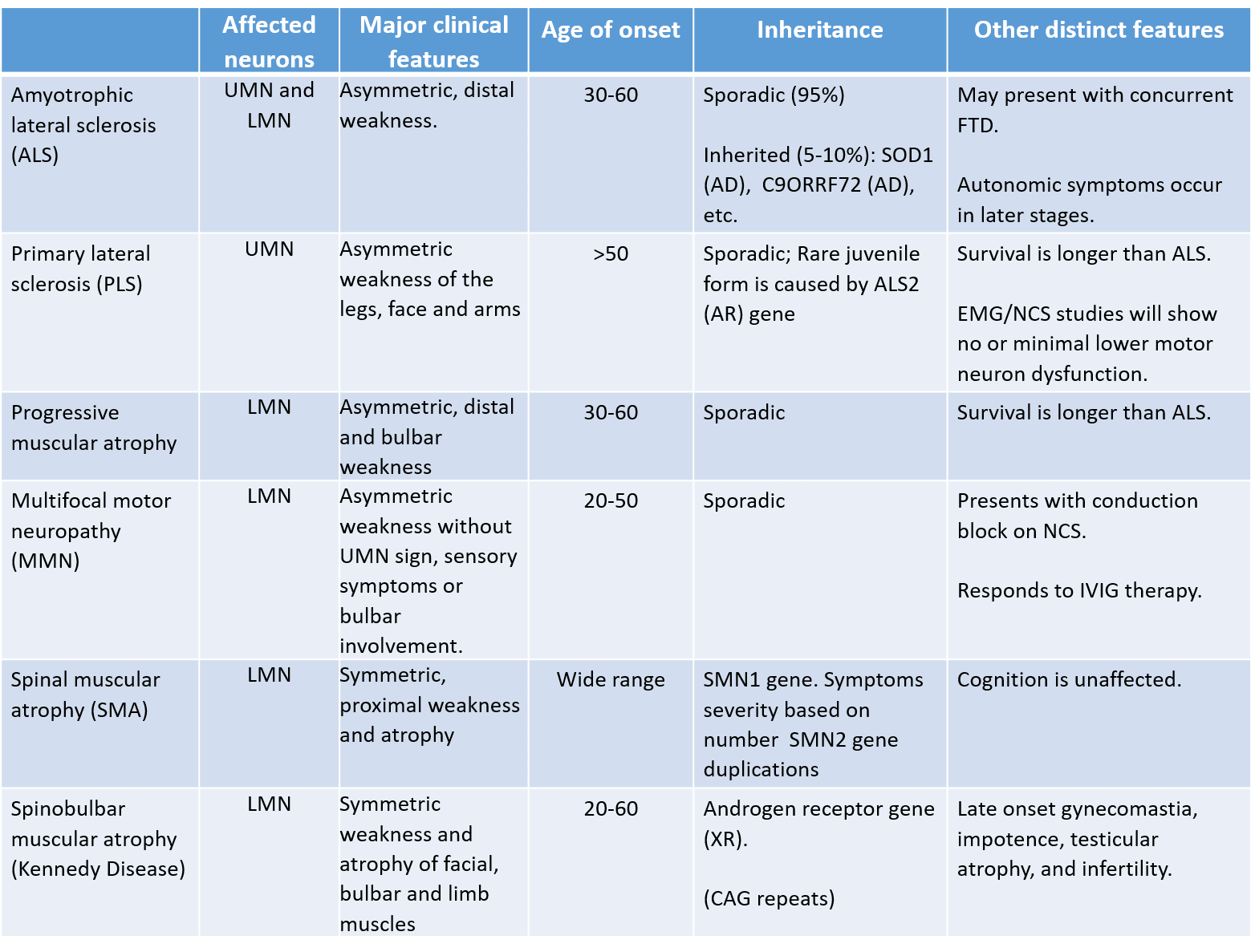
Table of Motor Neuron Diseases

Motor neuron disease chart
UMN- Upper motor neuron, LMN- Lower motor neuron, FTD- frontotemporal dementia, AR- autosomal recessive, XR- X-linked recessive, NCS- nerve conduction studies, EMG- Electromyography.

References

  1. Brooks, Benjamin Rix. “El Escorial World Federation of Neurology Criteria for the Diagnosis of Amyotrophic Lateral Sclerosis.” Journal of the Neurological Sciences, vol. 124, 1994, pp. 96–107., doi:10.1016/0022-510x(94)90191-0.
  2. Chio, Adriano, et al. “Prognostic Factors in ALS: A Critical Review.” Amyotrophic Lateral Sclerosis, 2008, pp. 1–14., doi:10.1080/17482960802566824.
  3. Kiernan, Matthew C, et al. “Amyotrophic Lateral Sclerosis.” The Lancet, vol. 377, no. 9769, 2011, pp. 942–955., doi:10.1016/s0140-6736(10)61156-7.
  4. Mueller, Steffen, et al. “Poliovirus and Poliomyelitis: A Tale of Guts, Brains, and an Accidental Event.” Virus Research, vol. 111, no. 2, 2005, pp. 175–193., doi:10.1016/j.virusres.2005.04.008.
  5. Muley, Suraj Ashok, and Gareth J. Parry. “Multifocal Motor Neuropathy.” Journal of Clinical Neuroscience, vol. 19, no. 9, 2012, pp. 1201–1209., doi:10.1016/j.jocn.2012.02.011.
  6. Nobile-Orazio, Eduardo, et al. “Multifocal Motor Neuropathy: Current Concepts and Controversies.” Muscle & Nerve, vol. 31, no. 6, 2005, pp. 663–680., doi:10.1002/mus.20296.
  7. OpenStax College, Anatomy & Physiology. OpenStax CNX. Aug 7, 2013 http://cnx.org/contents/[email protected].
  8. Parodi L, Rydning SL, Tallaksen C, et al. Spastic Paraplegia 4. 2003 Apr 17 [Updated 2019 Jun 13]. In: Adam MP, Ardinger HH, Pagon RA, et al., editors. GeneReviews® [Internet]. Seattle (WA): University of Washington, Seattle; 1993-2021. Available from: https://www.ncbi.nlm.nih.gov/books/NBK1160/
  9. Prior, Thomas W., et al. “A Positive Modifier of Spinal Muscular Atrophy in the SMN2 Gene.” The American Journal of Human Genetics, vol. 85, no. 3, 2009, pp. 408–413., doi:10.1016/j.ajhg.2009.08.002.
  10. Takei, Koji, et al. “Post-Hoc Analysis of Randomised, Placebo-Controlled, Double-Blind Study (MCI186-19) of Edaravone (MCI-186) in Amyotrophic Lateral Sclerosis.” Amyotrophic Lateral Sclerosis and Frontotemporal Degeneration, vol. 18, no. sup1, May 2017, pp. 49–54., doi:10.1080/21678421.2017.1361443.
  11. Tiryaki, Ezgi, and Holli A. Horak. “ALS and Other Motor Neuron Diseases.” CONTINUUM: Lifelong Learning in Neurology, vol. 20, 2014, pp. 1185–1207., doi:10.1212/01.con.0000455886.14298.a4.
  12. Traynor, Bryan J., et al. “An Outcome Study of Riluzole in Amyotrophic Lateral Sclerosis.” Journal of Neurology, vol. 250, no. 4, Jan. 2003, pp. 473–479., doi:10.1007/s00415-003-1026-z.
  13. Zaffran, Michel, et al. “The Polio Endgame: Securing a World Free of All Polioviruses.” The Lancet, vol. 391, no. 10115, 2018, pp. 11–13., doi:10.1016/s0140-6736(17)32442-x.

Loading table of contents...

Loading table of contents...


Log in to View the Remaining 60-90% of Page Content!


Important: If you signed up after 1/1/2026, or if you opted to migrate your old account to the new & improved platform (same great content, better experience), please log in at nowyouknowmed.com



New here? Get started!

(Or, click here to learn about our institution/group pricing)

1 Month Plan

Full Access Subscription
$142.49
$ 94
99
1 Month
  • Access to full question bank
  • Access to all flashcards
  • Access to all chapters & site content

3 Month Plan

Full Access Subscription
$224.98
$ 144
97
3 Months
  • Access to full question bank
  • Access to all flashcards
  • Access to all chapters & site content

1 Year Plan

Full Access Subscription
$538.47
$ 338
98
1 Year
  • Access to full question bank
  • Access to all flashcards
  • Access to all chapters & site content
Popular