Evoked potentials (EPs) are not a common topic on in-service or board examinations; Expect only a few questions on EPs on test day.

Medical students shouldn’t be expected to know much about evoked potentials after their neurology clerkship training. Neurology residents may have very little exposure to these diagnostic tests during their training. Because of this, it may be valuable to briefly cover the three most common evoked potential tests performed and seen on examinations: Brainstem auditory evoked potentials (BAEPs), Visual evoked potentials (VEPs), and Somatosensory Evoked Potentials (SSEPs).

Author: Brian Hanrahan, MD
Editor: Steven Factor, MD

Chapter Multimedia Content

Table of Contents
Loading table of contents...

Basics

  • Evoked potentials (EPs) are the electrical manifestation of the brain’s response to an external stimulus and can provide information regarding the functional integrity of sensory pathways. External sensory stimuli are somatosensory, auditory, or visual.
  • Each evoked potential (visual, somatosensory, auditory) has typical measurable waves that represent particular regions along its particular pathway. Depending on the recording location, EP waves can be peripheral nerve, subcortical (brainstem), or cortical. The presence or absence of EP waves, as well as wave latency and amplitude, can help determine functional status.
    • Each wave has a particular latency (msec) and amplitude (mV). 
    • Increased wave latencies indicate a conduction abnormality.

Brainstem Auditory Evoked Potentials (BAEPs)

  • BAEPs are utilized in various neurosurgical operations including acoustic neuroma resection, as well as removal of other tumors or vascular abnormalities within the posterior fossa. They are not useful in monitoring deep thalamic or cerebral auditory pathways.
  • BAEPs are produced by a brief auditory stimulus (click) to one ear.
  • BAEPs evaluate the peripheral (cranial nerve VIII) and central auditory pathways (cochlear nucleus, superior olivary nucleus, lateral lemniscus, inferior colliculus, medial geniculate body, and thalamocortical pathways).

  • Abnormal time intervals between particular waves (interpeak latencies) correlate with various lesions within the brain-stem auditory tract.
  • Clinical correlations:
    • If no Wave I is captured on the recording, no conclusions can be made regarding the auditory pathway.
    • When a bilateral auditory stimulus is given (rarely done clinically) in someone with unilateral peripheral hearing loss it will show a unilateral absence of Wave I with an intact ipsilateral Wave V since central auditory pathways are highly crossed.
    • Acoustic neuromas can cause a prolonged wave I-III interpeak latency.
    • Lesions in the pons can produce abnormalities in waves III, IV, and V.
    • Patients with multiple sclerosis are more likely to have an abnormal VEP than an abnormal BAEP or SSEP.
      • Prolonged III-V interpeak latency or decreased wave V amplitude can be seen.
    • Bilateral absence of all waves except for Wave I after a hypoxic-ischemic injury suggests a poor neurological outcome.
These are normal BAEPs. Note waves I, III, and V. Note that Wave I is only seen unilaterally.  That is because it is unmeasurable from the contralateral ear electrode.

Somatosensory Evoked Potentials (SSEPs)

  • SSEPs record activity of the peripheral nervous system as well as the dorsal column/medial lemniscal system.
  • SSEPs are recorded over the spine and scalp following the stimulation of large peripheral myelinated fibers. The ulnar or median nerves are typical upper extremity nerves stimulated. The tibial nerve is the typical lower extremity nerve stimulated.
  • Waveforms are different for upper and lower extremity SSEPs
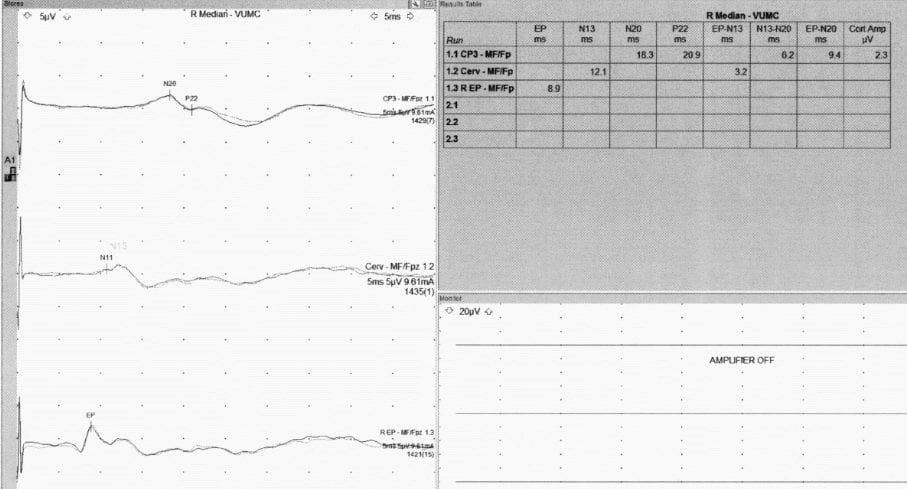
    • N20 (Primary cortical somatosensory cortex).

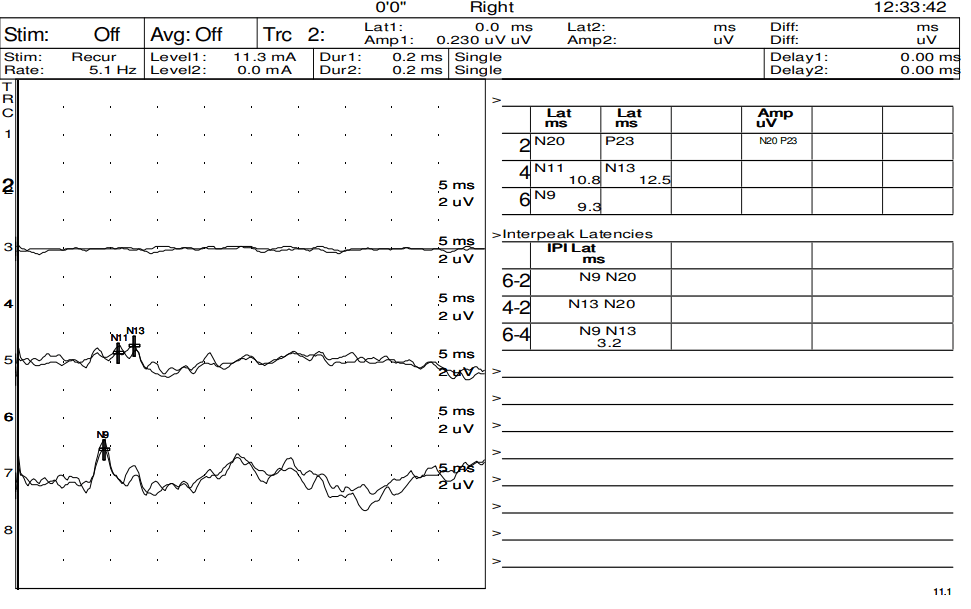
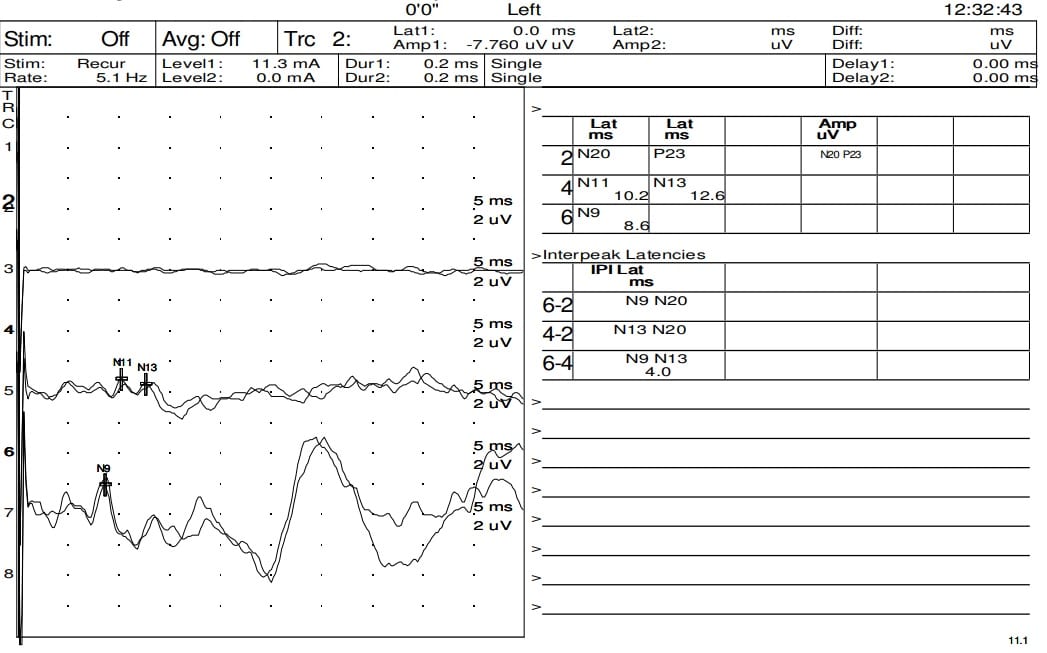
This is a normal right upper extremity of the median nerve
  • Clinical correlations:
    • Very valuable in monitoring for spinal cord injury in patients undergoing neurosurgical interventions near the spine.
Visual Evoked Potentials (VEPs)

  • VEPs can be produced by a flash of a strobe light or visualization of a checkerboard pattern where the boxes shift between black and white. Each eye is stimulated independently so that they can be compared. Patients sit one meter from the monitor.
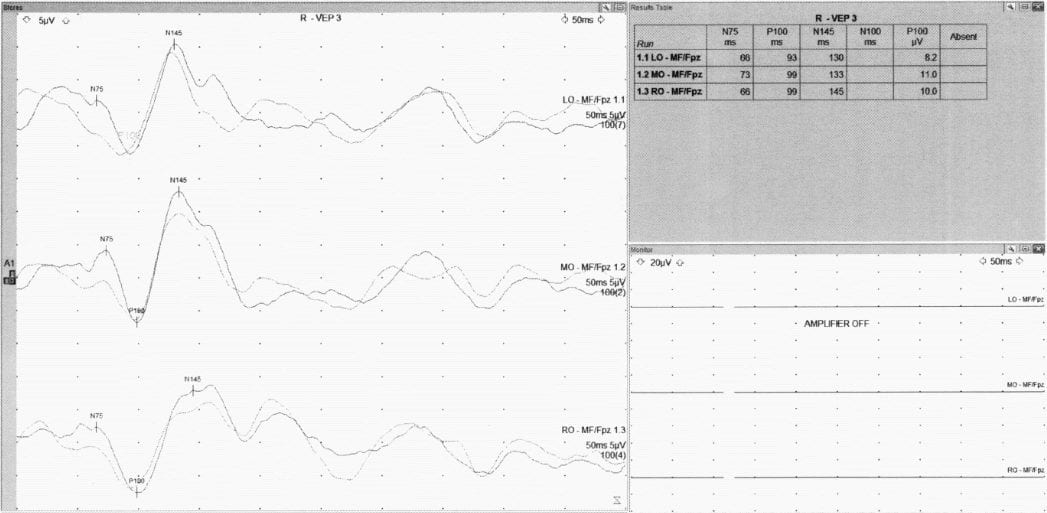
  • The wave of value in VEPs is the P100, which represents occipital cortex stimulation.
    • A prolonged P100 latency of a single eye would suggest a pre-chiasmal lesion of the optic pathway (i.e. optic neuritis), especially if the contralateral eye’s P100 latency is normal.
      • Hemifield stimulation with large check sizes is required to test post-chiasmal lesions, and even with this technique, only large lesions can be detected.
    • If both eyes have prolonged P100 latencies the location of a lesion cannot be localized unless one side is disproportionally more prolonged.
    • Poor visual acuity will lead to a decreased P100 amplitude.
  • Clinical correlations:
    • Optic neuritis (ON) and multiple sclerosis (MS):
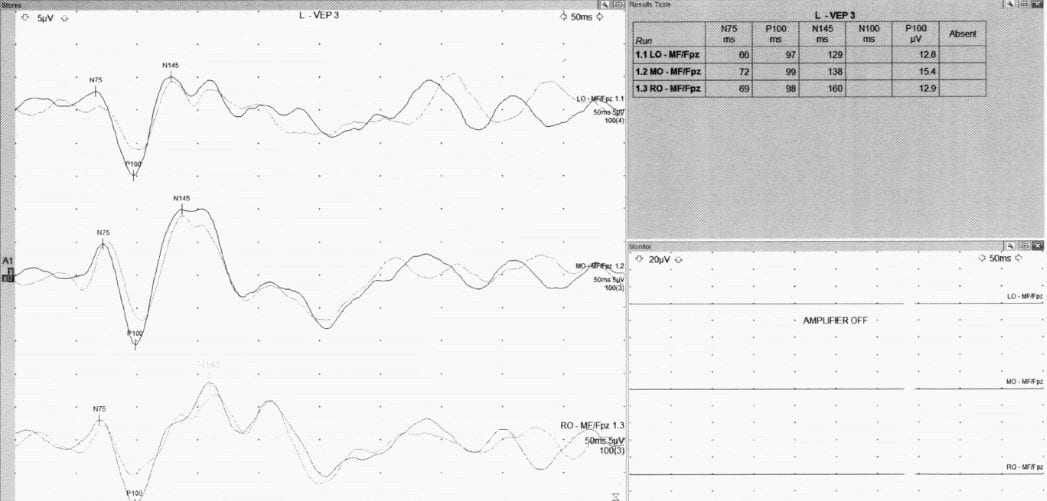
      • Very sensitive at detecting optic nerve demyelination secondary to optic neuritis/multiple sclerosis.
      • In patients with suspected MS who eventually develop MS, the diagnostic EP abnormalities are 66% for VEPs, 23% for SSEPs, and 13% for BAEPs. Thus, VEPs are superior to other EP modalities in diagnosing MS.
      • Abnormal VEPs with prolonged P100 latencies are very typical, even in patients with distant histories of ON who had a complete recovery in visual acuity.
      • Patients with ocular blindness will not have appreciable P100 waves.
    • Tumor compression of the anterior visual pathways may distort waveforms but doesn’t have a major impact on latency.

References

  1. Chiappa, Keith H., and Allan H. Ropper. “Evoked Potentials in Clinical Medicine.” New England Journal of Medicine, vol. 306, no. 20, 1982, pp. 1205–1211., doi:10.1056/nejm198205203062004.
  2. Creel, Donnell. “Visually Evoked Potentials.” Webvision: The Organization of the Retina and Visual System [Internet]., U.S. National Library of Medicine, 1 Mar. 2012, www.ncbi.nlm.nih.gov/books/NBK107218/.
  3. Daube, Jaster. “Evoked Potentials.” Continuum: Clinical Neurophysiology, vol. 4, no. 5, 1998, pp. 55-71.

Loading table of contents...

Loading table of contents...


Log in to View the Remaining 60-90% of Page Content!


Important: If you signed up after 1/1/2026, or if you opted to migrate your old account to the new & improved platform (same great content, better experience), please log in at nowyouknowmed.com



New here? Get started!

(Or, click here to learn about our institution/group pricing)

1 Month Plan

Full Access Subscription
$142.49
$ 94
99
1 Month
  • Access to full question bank
  • Access to all flashcards
  • Access to all chapters & site content

3 Month Plan

Full Access Subscription
$224.98
$ 144
97
3 Months
  • Access to full question bank
  • Access to all flashcards
  • Access to all chapters & site content

1 Year Plan

Full Access Subscription
$538.47
$ 338
98
1 Year
  • Access to full question bank
  • Access to all flashcards
  • Access to all chapters & site content
Popular